
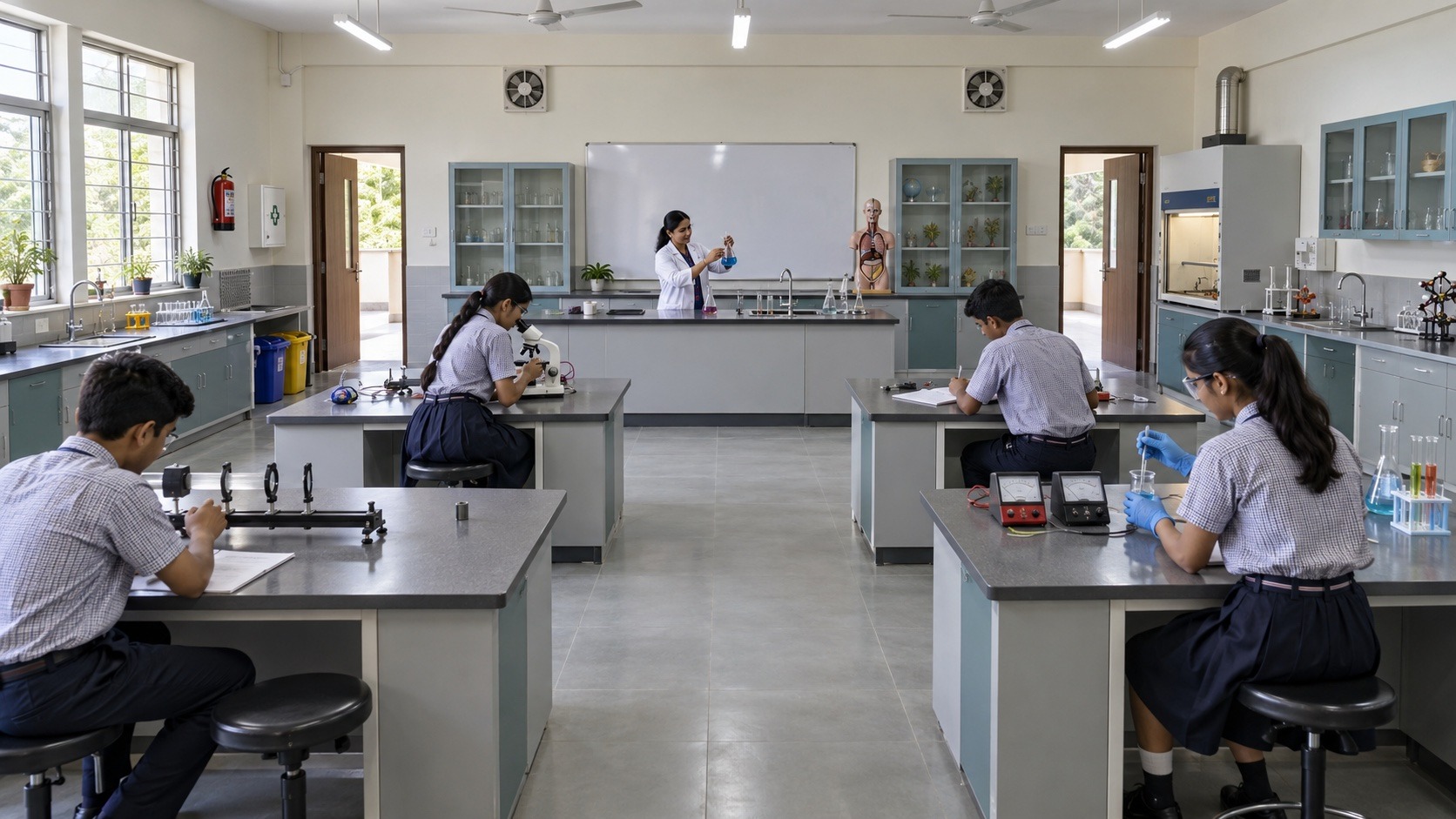
Bharat Scientific World provides complete CBSE Composite Science Laboratory setup for schools planning new facilities, upgrading an existing science room or preparing infrastructure for affiliation review. Our support covers site measurement, laboratory layout, customized furniture, utilities, Physics Chemistry and Biology equipment, storage, safety provisions, installation and organized handover. **Composite Science Laboratory Size and Planning** Current CBSE SARAS inspection fields identify a minimum Composite Science Laboratory size of 54 square metres, while the published CBSE Composite Science Laboratory SOP describes a minimum room size of 600 sq. ft. The laboratory should be planned as an integrated secondary-level practical space with clear student circulation, teacher supervision and accessible work areas. The layout can include student island benches, wall-side utility counters and a teacher demonstration table. The published SOP describes a demonstration table with an integrated sink and water tap, along with seating facilities for 40 students. Furniture dimensions and bench positions should be coordinated with the actual room, doors, windows and service points. **Water, Heating and Laboratory Utilities** The CBSE SOP lists eight sinks with water supply for the Composite Science Laboratory. These can be distributed through island benches or wall-side counters while retaining maintenance access to plumbing and drainage. The guidance also refers to a preferred gas pipeline with two heating burners and one laboratory heater for heat-related experiments. Electrical points can be planned for low-voltage Physics apparatus, microscopes and supporting equipment. Water, gas and electrical routes should be reviewed before furniture manufacturing so that worktops, service panels and storage do not obstruct maintenance. **Secure Storage and Teaching Facilities** Consumables and non-consumable equipment should be stored in a separate room or lockable cupboards that help maintain a safe, dust-free and vermin-free environment. Storage can include glass-front cupboards, lockable base cabinets, microscope cabinets, glassware sections, reagent racks and separate controlled chemical-storage arrangements. A whiteboard, green board or suitable digital teaching facility can support demonstrations. Display areas can be reserved for laboratory rules, safety procedures, practical lists, timetables and emergency contact information. **Physics, Chemistry and Biology Equipment** A Composite Science Laboratory may include microscopes, permanent slides, specimens and Petri dishes for Biology; test tubes, boiling tubes, beakers, conical flasks, funnels, separating funnels, china dishes, glass rods, droppers, tripod stands, wire gauze and thermometers for Chemistry; and spring balances, magnets, iron filings, mirrors, lenses, prisms, pinhole cameras, kaleidoscopes and magnetic compasses for Physics. Routine consumables can include slides, cover slips, litmus paper, indicators and syllabus-related chemicals. Equipment quantities and specifications should be checked against the latest applicable CBSE SOP, curriculum, student batch size and the school's existing stock before procurement. **Safety and Inspection Readiness** The published SOP calls for two wide and unobstructed exit doors, suitable fire extinguishers, two exhaust fans, two first-aid kits and separate bins for biodegradable and non-biodegradable waste. It also addresses periodic checks of electrical and gas fittings, secure chemical storage, proper labelling, teacher supervision and suitable protective arrangements such as a fume hood, goggles and gloves. Contact us for CBSE Composite Science Lab setup, CBSE SOP laboratory furniture, SARAS inspection-readiness support, school science equipment and complete turnkey laboratory solutions in Bengaluru and across India.


This is your website preview.
Currently it only shows your basic business info. Start adding relevant business details such as description, images and products or services to gain your customers attention by using Boost 360 android app / iOS App / web portal.
CBSE Composite Science Lab Setup for SOP and SARAS Readiness
2026-10-16T03:46:11
Bharat Scientific World provides complete CBSE Composite Science Laboratory setup for schools planning new facilities, upgrading an existing science room or preparing infrastructure for affiliation review. Our support covers site measurement, laboratory layout, customized furniture, utilities, Physics Chemistry and Biology equipment, storage, safety provisions, installation and organized handover. **Composite Science Laboratory Size and Planning** Current CBSE SARAS inspection fields identify a minimum Composite Science Laboratory size of 54 square metres, while the published CBSE Composite Science Laboratory SOP describes a minimum room size of 600 sq. ft. The laboratory should be planned as an integrated secondary-level practical space with clear student circulation, teacher supervision and accessible work areas. The layout can include student island benches, wall-side utility counters and a teacher demonstration table. The published SOP describes a demonstration table with an integrated sink and water tap, along with seating facilities for 40 students. Furniture dimensions and bench positions should be coordinated with the actual room, doors, windows and service points. **Water, Heating and Laboratory Utilities** The CBSE SOP lists eight sinks with water supply for the Composite Science Laboratory. These can be distributed through island benches or wall-side counters while retaining maintenance access to plumbing and drainage. The guidance also refers to a preferred gas pipeline with two heating burners and one laboratory heater for heat-related experiments. Electrical points can be planned for low-voltage Physics apparatus, microscopes and supporting equipment. Water, gas and electrical routes should be reviewed before furniture manufacturing so that worktops, service panels and storage do not obstruct maintenance. **Secure Storage and Teaching Facilities** Consumables and non-consumable equipment should be stored in a separate room or lockable cupboards that help maintain a safe, dust-free and vermin-free environment. Storage can include glass-front cupboards, lockable base cabinets, microscope cabinets, glassware sections, reagent racks and separate controlled chemical-storage arrangements. A whiteboard, green board or suitable digital teaching facility can support demonstrations. Display areas can be reserved for laboratory rules, safety procedures, practical lists, timetables and emergency contact information. **Physics, Chemistry and Biology Equipment** A Composite Science Laboratory may include microscopes, permanent slides, specimens and Petri dishes for Biology; test tubes, boiling tubes, beakers, conical flasks, funnels, separating funnels, china dishes, glass rods, droppers, tripod stands, wire gauze and thermometers for Chemistry; and spring balances, magnets, iron filings, mirrors, lenses, prisms, pinhole cameras, kaleidoscopes and magnetic compasses for Physics. Routine consumables can include slides, cover slips, litmus paper, indicators and syllabus-related chemicals. Equipment quantities and specifications should be checked against the latest applicable CBSE SOP, curriculum, student batch size and the school's existing stock before procurement. **Safety and Inspection Readiness** The published SOP calls for two wide and unobstructed exit doors, suitable fire extinguishers, two exhaust fans, two first-aid kits and separate bins for biodegradable and non-biodegradable waste. It also addresses periodic checks of electrical and gas fittings, secure chemical storage, proper labelling, teacher supervision and suitable protective arrangements such as a fume hood, goggles and gloves. Contact us for CBSE Composite Science Lab setup, CBSE SOP laboratory furniture, SARAS inspection-readiness support, school science equipment and complete turnkey laboratory solutions in Bengaluru and across India.
2026-10-16T03:46:11


Submit Your Enquiry